



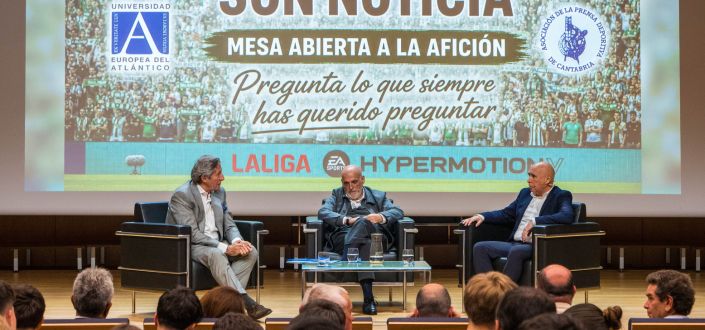
The Universidad Europea del Atlántico (European University of the Atlantic (UNEATLANTICO) was the scene of the open table for fans of LaLiga Hypermotion, a meeting that brought together representatives from professional football, academia and media to discuss the present and future of the competition, the audiovisual model and the social role of sport.
The event was attended by LaLiga president, Javier Tebas, the president of Racing de Santander, Manolo Higuera, and journalist Jesús Álvarez. The round table was moderated in an academic environment with students of Communication and Sciences of Physical Activity and Sport.
During the inauguration, the rector of UNEATLANTICO, Rubén Calderón, thanked the participation of the speakers and the collaboration of the involved sports entities. Calderón highlighted the importance of this type of initiatives for students, stressing the formative value of the meeting “both for CAFYD’s students and those in journalism.”
The president of Racing de Santander, Manolo Higuera, opened the dialogue by focusing on the decisive moment that passes through the Cantabrian club, immersed in the fight for promotion after 16 seasons of waiting. “We’re close, but we’re not there yet. On Saturday we have a decisive match in which everyone must be focused”, said Higuera, appealing to the team’s responsibility for a key final stretch. The manager also recalled personal experiences as a footballer in situations of maximum competitive tension, highlighting the difference between playing by descent or by promotion.
Javier Tebas highlighted the high competitiveness of LaLiga Hypermotion and the sporting and economic growth of the category, stressing that Racing “has enough merits to be in a superior category”.
The president of LaLiga highlighted the audiovisual model of the competition, as well as the international impact of Spanish football, with global figures that place the league among the most followed in the world. He also highlighted the increase in stadium attendance and audience growth, driven partly by the fight against piracy.
During his speech, Manolo Higuera reviewed the recent evolution of the club since his arrival at management, recalling an initial stage marked by economic and sporting difficulties.
The leader explained that the project has been based on “resilience” and long-term planning, which has allowed the team to grow progressively and consolidate as a candidate for promotion. Also, he highlighted the transformation of the style of play, with a more offensive and competitive team, able to overcome important scoring records in the current season.
The round table also addressed structural issues of professional football, such as possible internationalization of matches, calendar management, role of refereeing and technological evolution of VAR.
Tebas advocated the progressive modernization of the arbitration system and the incorporation of automatic tools to improve decision-making, while Higuera stressed the need for consensus among clubs in any structural change.
Another highlight was the distribution of audiovisual rights in the Second Division, where the need to balance resources between categories was discussed to ensure the sustainability of the clubs. One of the highlights of the meeting was the recognition to the fans of Racing de Santander, described by the speakers as an example of loyalty and exemplary behavior.
Higuera stressed the absence of incidents in recent years and highlighted the growing presence of young people and women in the social mass of the team, reflecting a transformation in the profile of the amateur.
The day ended with a common message of optimism about the future of Spanish football and the role of LaLiga Hypermotion as a growing competition, as well as the importance of collaboration between sports and academic institutions.
From UNEATLANTICO, the meeting was consolidated as a space for learning and debate, bringing the reality of professional football closer to the university community and reinforcing the link between sport, education and society.