



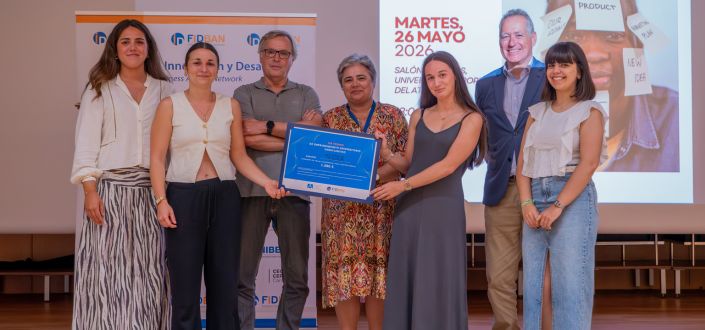
The Universidad Europea del Atlántico (European University of the Atlantic, UNEATLANTICO) celebrates the I Entrepreneurship Award of the Foundation for Innovation and Development (FIDBAN), with more than 50 innovative projects in a final marked by social impact, technology and sustainability.
The day began with the welcome of Maria Paulina Acosta, who was responsible for acting as a master of ceremonies during the event, giving way to an intense round of presentations to investors, experts and attendees from very diverse profiles, from psychology and computer engineering to advertising, CAFYD, IOI and Erasmus students
Then, Diego Lainz, director of FIDBAN explained what the foundation is and thanked the involvement of the university, participants and collaborating entities. During his speech, he also highlighted the activity that the foundation develops throughout Latin America together with FUNIBER, promoting entrepreneurship and the connection between innovative projects and international investors. He also congratulated all the students for the work done and for the high level of the proposals presented.
Subsequently, the finalist projects were officially presented and a jury of experts was appointed to evaluate each initiative based on five key criteria: innovation, feasibility, social impact, scalability and presentation.
Among the finalist projects were proposals focused on well-being, social inclusion, sustainability and artificial intelligence applied to improve people’s lives.
The first prize went to Yester, an artificial intelligence-driven emotional therapy application aimed at elderly people with mild cognitive impairment. The tool uses photographs, audios and family memories to create personalized daily challenges that help combat loneliness, stimulate memory and preserve life stories. The team consists of Ariadna Cuevas, Noa Castro, Nahia Galán, Marta Luis, Lucía Floranes and Dayana Escudero.
The innovation mention was given to Aura Link, a discreet wearable designed for people with facial paralysis. The device employs sEMG sensors and artificial intelligence to translate nerve impulses into visible emotions through haptic signals and expressive avatars, facilitating new forms of emotional communication. The project was developed by Clara Greavu, Mumeen Gbolagade and Paul Wennik.
The mention of business viability and scalability came from Break & Go, an innovative wellness center that combines private rest cabins with a functional cafeteria. Their “RelaxPods” offer sound insulation, adjustable lighting and digital bookings via a mobile app. The team is composed of Laura Alonso, Ismael Collera, Paula Díaz-Velarde, Lía Penélope Marzo, Noa Pinillos and Aitana Salas.
Also, the mention of social impact was for Small Footprints, a therapeutic farm aimed at children and neurodivergent people. The project focuses on supervised therapies in contact with nature and animals to improve communication, motivation and social interaction. Its members are Laura Díaz de Entresotos, Sara Herbosa, Carmen Fernández, Érika Dorohkotova and Laura Cabrero.
Among the finalist projects also stood out Vivara, a proposal of modular and sustainable housing for young people based on an option-to-purchase rental model. The project envisions accessible and community homes built with eco-friendly materials, solar energy and shared spaces. It is driven by Jaime Guerra Heras, Ana Ibáñez Ruiz, Víctor Higuera Aja, Sergio Gallardo Baltodano and Francisco A. Castillo Babilonia.
Another of the projects presented was Brainfy, neuroadaptive headphones that incorporate EEG sensors and artificial intelligence to select music based on the user’s mental state. The tool aims to improve concentration and reduce stress through personalized playlists and real-time emotional monitoring.
Also involved was SPARK, a smart parking system for cities and campuses based on IoT sensors that detects empty spaces in real time and guides users via GPS, reducing traffic, search times and emissions. The project was developed by Rubén Setién.
The conference once again highlighted students’ entrepreneurial talent and growing interest in projects that combine technology, sustainability and social impact to respond to real challenges of today’s society.