



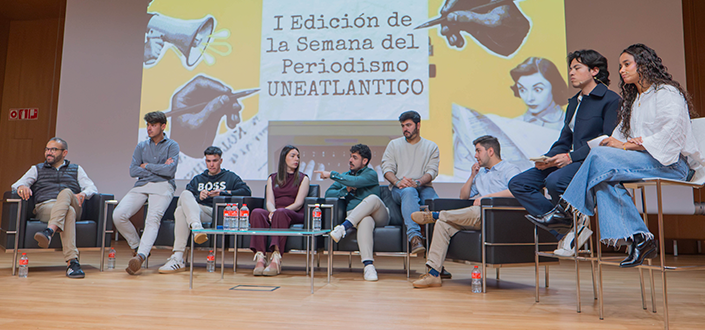
The Universidad Europea del Atlántico (European University of the Atlantic, UNEATLANTICO) has celebrated the I Week of Journalism, a meeting dedicated to bring the reality of the world of communication to students through the experience of professionals in active.
The day, presented by the director of degrees in communication, Helena Garay, featured various round tables, presentations and reflections on the current challenges of journalism and job placement in the sector.
During the opening, it was highlighted that the main goal of this first edition was to “explain the reality of the world” from the experience of those who already work in media. The student of the third year of Journalism, Maximiliano Pedroza and Lia Penélope, a fourth-year student of Audiovisual Communication were responsible for introducing the participants of the first table, focused on the leap from the classroom to the world of work.
Álex García, journalist at the COPE network in Cantabria opened the colloquium talking about his professional beginnings and underlined an idea that was repeated throughout the day: the importance of the initiative. “If someone wants to do journalism, journalism is not going to go to anyone,” he said, encouraging students to practice, knock on doors, and move constantly. In the same vein, Óscar García Mayo, head of sports at Cadena SER, insisted on the need to “be in constant movement,” while Lucio del Campo, a journalist at Diario Montañés, recalled that “journalism does not wait,” and recommended starting to seek practices as soon as possible.
The speakers agreed that vocation is important, but so are adaptability and continuous training. Kike Serrano, a journalist at the EFE Agency highlighted the growing importance of photography and video in the profession, assuring that “journalists gradually have to get into the world of multimedia.” Laura Samperio, from RTVE Cantabria, put in value subjects like radio and television and pointed out that approaching the working environment as soon as possible is “fundamental”.
Another central issue was the need to make the most of the resources offered by the university. Lucio remarked that the years of training “serve and form in every discipline”, although he insisted that practices are essential to discover which area of journalism each student likes most. Álex also encouraged “not to close doors”, explaining that although he started wanting to work in narrating Racing matches, he now also does informational and has discovered new professional facets that he enjoys even more.
The day left numerous tips for future journalists. Among them, the importance of polyvalence, self-assurance and organizational capacity. “If they ask you for anything, do everything,” said Laura. Oscar highlighted the need to have a broad education and know how to “sell”, while Adrián Lacuesta, creator of the digital media La Cabaña de Deportes defined journalism as “a very beautiful but very difficult world,” although he ensured that anyone who really wants to dedicate themselves to it “He’ll get it.”
Participants also reflected on employability in the sector. Although they recognized the current difficulties of the market, they agreed that opportunities come to those who move, make contacts and take advantage of each experience. “One door opens another door,” said Oscar, while Kike insisted that “the important thing is to know how to take advantage of initiatives.” In addition, students were encouraged to use tools such as LinkedIn and to present themselves directly in media and even small companies to make themselves known.
The meeting concluded with the intervention of Elsa Cabria and the presentation of her project “A Path of Listening”, a sound and journalistic tour through different cities such as Ceuta, Madrid, Seville, Mexico City, Guatemala, Valencia and Santander. Through several episodes, the journalist shared personal experiences and reflections on narrative journalism, the podcast and the importance of listening, moving and approaching other professionals in the sector.
The I Week of Journalism ended with the award of the first prize for journalism, marking a period marked by learning, vocation and direct contact between students and communication professionals.