



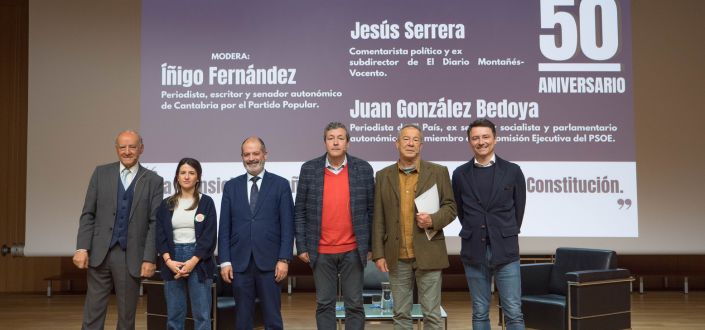
The Universidad Europea del Atlántico (European University of the Atlantic, UNEATLANTICO) hosted a round table on the occasion of the 50th anniversary of democracy in Spain, a meeting focused on the analysis of the Transition, the 1978 Constitution and the role of journalism in the democratic consolidation of the country.
The day, presented by Rubén Calderón and moderated by Íñigo Fernández, was attended by journalists Juan González Bedoya and Jesús Herrera, who reviewed some of the main political and social milestones of the Spanish Transition and reflected on the current state of democracy and media. Also, the round table was held at the initiative of Reformismo 21 and under the coordination of MP Alejandro Liz.
During his speech, Íñigo Fernández defined the Transition as “an agreement between leaders of different political sensibilities” that allowed to open, after the death of Francisco Franco, a path towards the integration of Spain into the European democratic framework. The moderator recalled that, although there was no concrete roadmap for achieving this model, there was a goal shared by much of the political class at the time.
Fernández also highlighted the value of the 1978 Constitution, which he described as “the first constitution resulting from a very broad consensus” in the history of Spain. “The greatness of the ’78 Constitution is that it belongs to everyone,” he said.
For his part, Juan González Bedoya, a journalist who worked in media such as Alerta, El Correo Español, La Hoja del Lunes and El País, as well as being a senator for Cantabria between 1982 and 1993 on behalf of the PSOE, recalled the difficulties of the last years of Francoism and the beginning of the Transition.
Bedoya explained that even before Franco’s death there were two distinct political currents: those who advocated a total break with the dictatorship and those who bet on a progressive reform of the system. The journalist, who acknowledged having been a partisan of the rupture, nevertheless stressed that the reform process “ended up being in many aspects rupturer”.
During his speech, he recalled the difficulties of practicing journalism during the dictatorship, a stage in which, according to him, one lived “underground”, under censorship and with constant pressure on the media. “Those were tough years,” he said, even recalling the bombing of newspapers and the instructions given to editors on how to headline certain news items.
The journalist also argued that the Transition was successfully completed thanks to, among other factors, Spain’s entry into the European Economic Community in 1986 and the development of economic and social reforms that consolidated the welfare state and public freedoms.
Jesús Herrera, former deputy director of El Diario Montañés and current political analyst, also made a “very positive” assessment of the Constitution and the Transition, emphasizing “the generosity and political height” of the leaders of that stage.
Herrera regretted that critical speeches about the Transition are now proliferating and said that, despite its improvements, the consensus effort of then contrasts with “sectarian attitudes” and the current political tension.
It also highlighted the preparation and career path of many leaders of that era, in the face of a current political reality in which, in his opinion, “the apparatus rules” and many public offices remain in politics for lack of a professional trajectory other than her.
The meeting also addressed issues such as the autonomous model, pending reforms of the Constitution, the electoral system or the quality of the current political class. Bedoya warned of the difficulty of amending the 1978 Constitution and noted that “if you open that melon it is difficult to close”.
In the final stage of the round table, participants reflected on the role of journalism in democracy. Bedoya rejected the idea of a true “fourth power” and argued that the fundamental principles of the office remain “freedom and truth.”
“Journalism is people who tell people what happens to people,” summed up the veteran journalist, who lamented the profession’s loss of credibility and deterioration in recent years.
For his part, Jesús Herrera stressed the need to recover the rigor of information and warned about the growing confusion between journalistic work and content disseminated through social networks.