


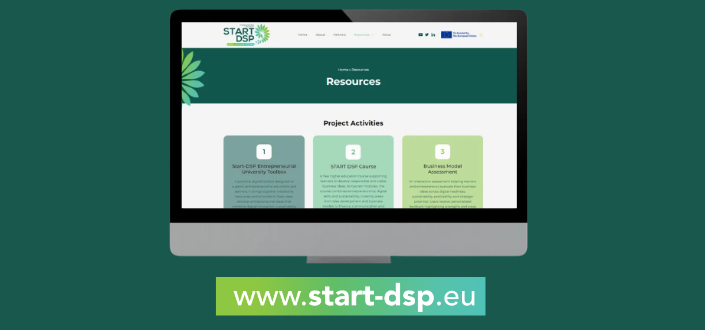
The European Erasmus+ project “Start Digital – Sustainable – Profitable” (Start-DSP), in which the Universidad Europea del Atlántico (European University of the Atlantic, UNEATLANTICO) participated alongside other European institutions, recently concluded with the publication of numerous educational resources on entrepreneurship.
The project promotes entrepreneurship education by equipping higher education students, educators, and future entrepreneurs with the competencies needed to develop sustainable, digitally innovative, and economically viable businesses.
The materials developed are available free of charge and in several languages, including Spanish. One of the educational resources developed during the project is an online course designed to help participants develop business ideas that address current environmental, social, and digital challenges. The course is divided into ten modules, each focusing on a key stage in the development of a business idea. The process ranges from the mindset and development of the idea to the business model, communication, financial planning, and governance.
Another product developed is a assessment tool, which is designed to help entrepreneurs, students, and educators analyze business concepts from this integrated perspective. The assessment helps reflecting on the strengths and areas for improvement in your business idea. By guiding users through a structured series of questions, it allows for an assessment of how digital technologies, the sustainability approach, financial viability, and long-term strategic potential are integrated into the core concept.
Another resource developed as part of the project is a knowledge center, where you can find practical, free-access resources. This center brings together videos, podcasts, blogs, tools, academic sources, open educational resources, case studies, and a self-assessment tool—all designed to help you integrate a digital, sustainable, and ethical mindset into entrepreneurship.
UNEATLANTICO Announces the Results to Its University Community
On September 17th, a dissemination event was held via YouTube to present the main results and resources generated by the project. The event was moderated by Dr. Thomas Prola and featured Dr. Emmanuel Soriano Flores, the project’s principal researcher, as well as guests Aline Noyola de la Llave, co-founder of Komuni, a startup focused on rural and community-based tourism, and Lina Landínez, executive director of ACEEU, the lead organization for the Start-DSP project.
Thomas Prola opened the event by presenting the project’s objectives and highlighted the commitment to integrating three areas of competencies: digital, entrepreneurial, and green skills. He also explained the various resources that have been developed, including training modules, hands-on activities, gamification, and tools for designing and evaluating business models.
Next, Emmanuel Soriano Flores explained the research process that made it possible to identify the needs of students, teachers, and entrepreneurs and subsequently translate them into a competency framework and a training curriculum. He highlighted five key areas: sustainable business models, digital transformation, resource and risk management, community and ethical impact, and environmental and social responsibility. One of Star-DSP’s main contributions is to integrate these areas, ensuring that digitalization, entrepreneurship, and sustainability are not treated as isolated competencies.
The second presentation was given by Aline Noyola de la Llave, who shared the experience of Komuni, a venture that grew out of her doctoral research on community-based tourism in Mexico. She explained how academic research identified problems related to the lack of digitization among many rural tourism ventures and how Komuni evolved to offer an ecosystem that combines visibility, technology, training, digital marketing, and booking generation. Her presentation emphasized that social impact must be complemented by profitability, scalability, and sustainability. Among her main takeaways, she emphasized the need to start with the problem rather than the technology, validate ideas with the market, measure both impact and sales, and build models that can stand the test of time.
For her part, Lina Landínez, executive director of ACEEU, discussed the role of universities as agents of social, economic, and cultural transformation. She presented European examples focused on sustainability, digitalization, entrepreneurship, and social engagement, emphasizing the importance of preparing students not only to acquire knowledge but also to take action and adapt that knowledge to different contexts.
The event concluded with a Q&A session with the audience and a demonstration of the Start-DSP tools.
In conclusion, the event demonstrated how Start-DSP seeks to bridge the gap between research, education, and business practice, promoting entrepreneurship focused on solving real-world problems and capable of combining social and environmental impact with economic viability.
Those interested in the Start-DSP project can learn more about it on its website, X, and LinkedIn.

“Funded by the European Union. However, the views and opinions expressed are solely those of the authors and do not necessarily reflect those of the European Union or the Nationale Agentur für Erasmus+ Hochschulzusammenarbeit (NA-DAAD). Neither the European Union nor the granting authority can be held responsible for them.”