


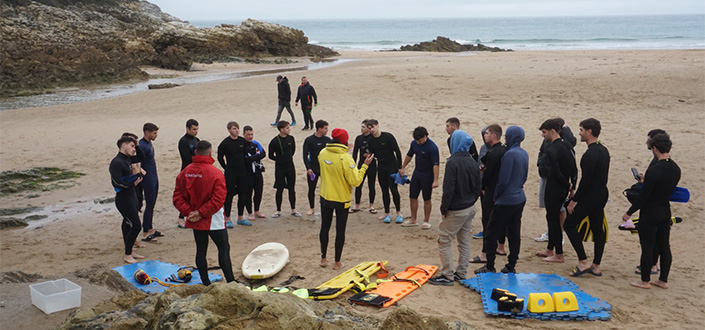
Fourth-year students in the Degree in Sports and Exercise Science (CAFYD) at the Universidad Europea del Atlántico (European University of the Atlantic, UNEATLANTICO) are acquiring knowledge and skills in emergency response through the Water Rescue and First Aid subject, taught by professors Adrián Rodríguez and Juan Aparicio.
The subject aims to equip future professionals with the tools to prevent accidents in school, sports, and aquatic settings, as well as to perform rescues and respond to emergency situations, minimizing their consequences through the application of first aid.
To that end, the sessions include a significant practical component, with a particular focus on natural aquatic environments. During the training sessions, students conduct rescue drills using various propulsion and flotation devices, through which they learn to handle different situations and use the available resources effectively.
After the rescue, students must perform a detailed primary assessment of the victim to determine their condition and provide the necessary care. To do this, they use basic life support techniques and first-aid kit supplies. In addition, the subject covers other safety-related topics, such as emergency response plans, the chain of survival, and the teaching and instruction of first aid.
The assessment combines practical assignments in real-world contexts with exams at sea. In these exams, students are organized into teams of three first responders and must solve a random case study, coordinating efficiently and applying the resources and knowledge they have acquired during the subject.
In this way, UNEATLANTICO is committed to providing hands-on training that enables its students to develop the fundamental competencies needed to prevent accidents and respond appropriately to emergency situations in their future careers.