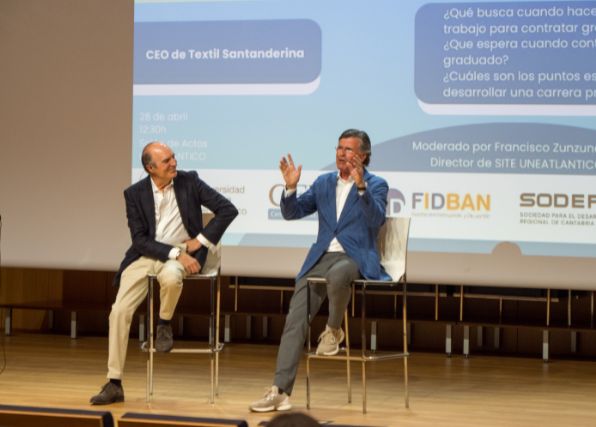
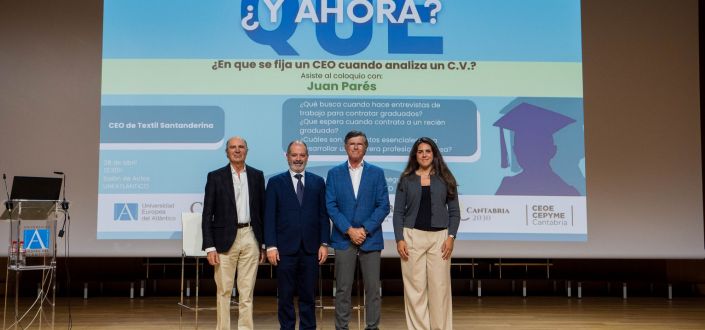
In a new day of the cycle “And now what”, organized at the Universidad Europea del Atlántico (European University of the Atlantic, UNEATLANTICO), the entrepreneur Juan Parés led a talk focused on guiding young people about their access to the world of work and the functioning of the business environment. The meeting, presented by Zunzunegui, served to bring the company’s reality closer to students from a human and practical perspective.
During his intervention, Parés defined the company as “a group of people aligned with a purpose”, stressing that this purpose “has little to do with the company and much with the person”. In this sense, he insisted that the real goal must be “to make every person better every day”, although he acknowledged that putting it into practice “is not as easy as saying.”
The entrepreneur focused on the core values that every worker must bring: “work, humility, commitment and stability.” In addition, he highlighted the importance of emotional balance, understood as the balance between family and professional life, making clear that, in his scale of priorities, “first comes the family and then work.”
One of the most relevant moments of the talk came when addressing the selection processes. Asked why he looks in a resume, Parés was emphatic: the CV “is only an approximation” and does not reflect a person’s true potential. “Paper can’t take everything,” he said, advocating direct contact as the main method: “I call the person and talk to them.”
In his opinion, beyond a brilliant record, companies are looking for attitude and ability to learn. “The important thing is humility, in the sense of knowing that you have no idea about anything,” he said. He also emphasized the importance of “reading a lot, listening and working side by side,” as well as the capacity for effort and endurance: “if you learn to suffer and obey, then you know how to command better.”
About the mistakes, he sent a clear message to the attendees: “the problem is not making a mistake, but how you react to it.” As for the interviews, he recommended preparing them “as if it were an exam”.
Parés also emphasized the importance of language as a professional tool. “Mastering grammar is key to communicating efficiently,” he explained, adding that English is “fundamental,” especially in an international context.
Regarding recent graduates, he noted that their entry into the labor market requires a lengthy learning process: “at least four or five months to understand the technical part of the company.” To this is added, as he explained, the need to acquire international experience and know customers in depth, since “the art of selling is the art of closing contracts”.
During the talk, the entrepreneur also addressed more personal aspects, such as managing frustration. “You overcome yourself by believing that you are the best,” he said, encouraging students to trust their potential and challenge themselves. “Every day the sun rises and it is always possible to do better,” he added.
Parés defended the importance of maintaining one’s identity in the professional environment: “do not lose your identity,” he advised, assuring that “a person is more valuable than a boss, if that boss is not a person.”
At the business level, he pointed out that the industry is driven by innovation and commercialization, and gave as an example sustainable initiatives within the textile sector, such as recycling plastics to convert them into yarn or the use of photovoltaic energy in production processes.
He also warned about future challenges, mentioning the impact of artificial intelligence and, especially, quantum computing, which in his view will “change society more than companies themselves.”
The talk ended with a direct message to attendees: bet on your ideas, differentiate yourself and learn from experience. “Life is very short and we have to learn from the elders,” he concluded.