


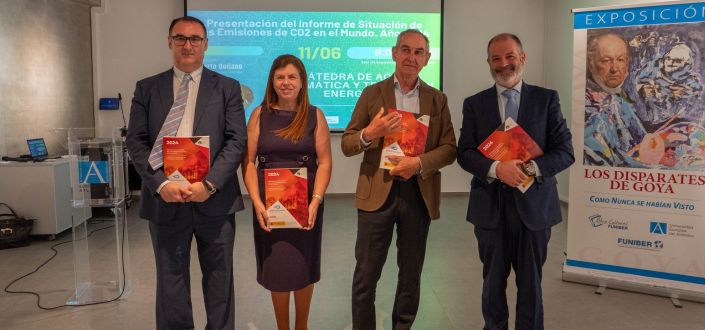
The Universidad Europea del Atlántico (European University of the Atlantic, UNEATLANTICO) hosted the presentation of the 2024 Emissions Status Report, a key document prepared by the Empresa y Clima Foundation that analyzes trends in greenhouse gas emissions at the international, national, and regional levels based on data from 2024.
The event was introduced by the university president, Rubén Calderón, who highlighted the importance of specialized training in the environmental field and the various sustainability-related degree programs offered by the university. The event was then officially opened by Alberto Quijano, Director General of Environment and Climate Change, and Elvira Carles, Director of the Fundación Empresa y Clima, the organization responsible for producing the report.
During his remarks, Quijano highlighted Carles’s career, with more than three decades of experience in the fight against the climate emergency, and emphasized the report’s relevance as a tool for analyzing and anticipating trends. He also noted that the increase in emissions recorded during the most recent period analyzed underscores the need to continue promoting reduction measures and the energy transition.
For her part, Elvira Carles described the report as “a snapshot of the planet’s situation in 2024,” noting that it has established itself as a benchmark publication for international organizations, financial institutions, and climate decision-makers. As she explained, the document is consulted by entities such as the United Nations and the World Bank to assess the evolution of emissions and future prospects.
Among the report’s main findings, it highlights that China remains the leading emitter of carbon dioxide from the energy sector, accounting for nearly 30% of global emissions. It is followed by the United States, with 13%, and India. Together, these three countries account for more than half of the planet’s emissions, underscoring the importance of international cooperation to advance climate goals.
The study also notes that electricity and heat generation is the primary source of emissions worldwide, accounting for 45% of the total. Road transport and manufacturing industries follow.
Experts also analyzed the efficiency of different economies in relation to their emissions. In this regard, the European Union stands out for generating high levels of wealth with relatively low emissions intensity, while China is moving toward more efficient models. India, on the other hand, continues to face significant challenges in this area.
In the case of Spain, the report shows a 7.7% reduction in emissions compared to 1990 levels. The speakers noted that, although emissions continued to rise for decades, Spain has managed in recent years to meet its established climate commitments.
However, transportation remains the main challenge for decarbonization. In fact, this sector has become the main source of emissions within the European Union, surpassing even the energy sector.
The influence of meteorological factors on the evolution of emissions in Spain and Portugal was also discussed. The presence of Atlantic winds favors wind and hydroelectric power generation, increasing the share of renewables and reducing dependence on fossil fuels.
At the regional level, Cantabria shows a trend consistent with its industrial structure. The 16 facilities subject to emissions verification in the region recorded nearly two million tons, representing approximately 1.5% of the national total of facilities covered by European directives.
The data presented during the conference show a downward trend in emissions in the region, maintaining a balanced relationship between productive activity and environmental control. The combustion sector remains the primary source of emissions within the autonomous community, although indicators point to a positive trend in line with sustainability goals.
With initiatives like this, UNEATLANTICO reaffirms its commitment to scientific outreach and sustainability education, fostering spaces for reflection on one of the greatest environmental challenges of the 21st century
Furthermore, within the framework of UNEATLANTICO’s Chair of Climate Action, the International Climate Action Congress (CIACC) will be held on July 1 and 2, a gathering that will bring together experts, researchers, institutional representatives, and industry professionals to address the main challenges and opportunities of the transition toward more sustainable models.