


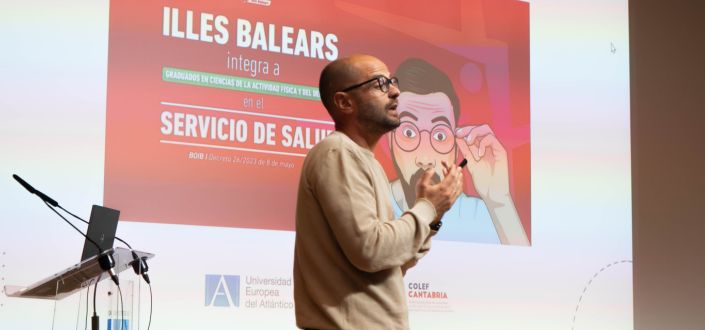
The Universidad Europea del Atlántico (European University of the Atlantic, UNEATLANTICO) hosted a conference on the organization of sport in Spain and the role of COLEF, an entity that represents the professionals of Physical Education and Sports Sciences in Spain.
The session began with the intervention of Florent Osmani, head of coordination of the Degree in Physical Activity and Sports Sciences of the university, who welcomed the attendees and presented the development of the day.
Next, Javier Cubero, president of COLEF Cantabria, explained the structure of the sports system in Spain, highlighting the organization at state, autonomous and local levels, and emphasizing the need for coordination between administrations. “The sports system in Spain is structured into different levels of state, autonomous and local administration that must be coordinated with each other. This structure makes sports management complex, but also very rich in terms of professional skills and opportunities.”
Subsequently, Raúl Yudego, director of the Municipal Institute of Sports of the Municipality of Burgos, focused his intervention on sports management at local level, explaining the role of municipalities in promoting physical activity, the maintenance of facilities and organisation of sports programmes. “Municipal sports management is key because it is the first level of access to sport for citizens. The city councils are responsible for facilities, promotion of physical activity and organization of sports programs, although it is a complex management due to costs and high demand for use”, he noted.
For his part, Antonio Rubio, manager of COLEF Castilla-La Mancha, addressed the transition from academic to professional, emphasizing the importance of college and knowledge of the labor market. “The transition from classroom to professional practice requires continuous training and a clear understanding of the value of collegiality. COLEF not only represents professionals, but also protects the profession and helps regulate access to the labor market,’ he said.
The day concluded with a round table in which the current challenges of the profession, the importance of regulating the sector and the growth of physical activity in society were discussed. The speakers agreed to highlight the fundamental role of sports management at all administrative levels and the need for qualified professionals to face the challenges of the sector.