


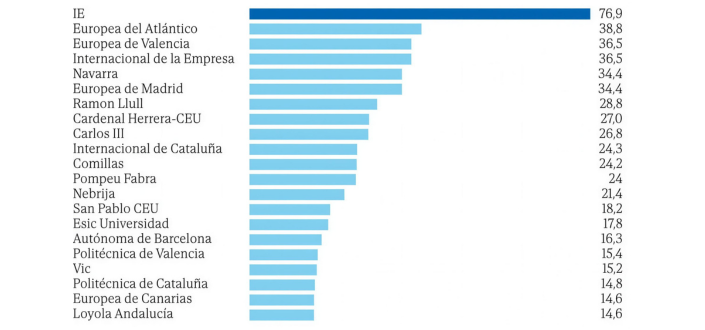
The Universidad Europea del Atlántico (European University of the Atlantic, UNEATLANTICO) is the university in Spain with the second-highest percentage of international students. This is revealed in a report by the BBVA Foundation and Ivie, which ranks the Cantabrian institution among the leading examples of university internationalization in the country, with 38.8% of its student body coming from abroad.
This figure takes on particular significance in a context where Spain continues to rank below the average for the Organization for Economic Cooperation and Development (OECD) and the European Union in terms of university internationalization. According to the study, conducted as part of the U-Ranking program, international students account for 5.2% of the total university student population in Spain, compared to the 8.6% reported by the OECD and the 9.8% European Union average. Furthermore, the study shows that the ability to attract international students is concentrated in a small number of institutions, as just 20 universities account for 60% of the international students enrolled in the country.
In this context, the Universidad Europea del Atlántico stands out for its ability to attract talent from around the world. With 38.8% of its student body consisting of international students, it ranks second nationally, trailing only IE University (76.9%) and ahead of other institutions such as the Universidad Europea de Valencia, the Universidad Internacional de la Empresa, and the Universidad de Navarra.
These results reflect UNEATLANTICO’s commitment to an educational model with a strong international focus, in which cultural and academic diversity is one of the core values of the university experience. UNEATLANTICO’s rector, Rubén Calderón, emphasizes that internationalization is part of an academic initiative aimed at improving students’ employability. “The university has a responsibility to transfer knowledge and skills that enhance employability, and in that regard, two elements are particularly important: entrepreneurship and internationalization,” he explains.
He also emphasized that internationalization is not limited to student mobility but also involves “internationalizing the classroom,” allowing students of different nationalities to share learning spaces and experiences. “Daily interaction with students from other countries improves intercultural skills, broadens students’ worldview, and better prepares them for an increasingly global job market,” he notes.
The report highlights that greater internationalization helps broaden students’ horizons, improve graduates’ employability, and strengthen the reputation of higher education institutions. It also notes that Spanish universities primarily attract students from Latin America and Europe, who account for 44% and 35% of the international student body, respectively.
Internationalization is one of the strategic priorities of the Universidad Europea del Atlántico, which in recent years has fostered an extensive network of partnerships with universities, institutions, and organizations in various countries. Through academic mobility programs, international exchanges, and cooperation projects, the university promotes an education that addresses the challenges and opportunities of an increasingly globalized world.
In this regard, Calderón highlights the importance of initiatives such as the Erasmus+ program and the bilateral agreements the university has with institutions in Europe, America, and Africa. “We strive to provide international experiences that enable our students to develop new skills, improve their adaptability, and strengthen the skills that are increasingly in demand by companies,” he explains.
The study also highlights that private universities generally have a greater ability to attract international students than public universities. While the former have an average of 20.7% international students, the latter stand at 8.9%. In this context, UNEATLANTICO’s performance figures place it significantly above the national average and establish it as one of the leading institutions in this field.
Calderón also believes that higher education should be viewed as a true knowledge industry, capable of generating wealth, attracting talent and contributing to economic development. “When you expand a sector internationally, you enhance its local impact. Higher education not only trains professionals but also builds human capital, drives innovation, and strengthens regional competitiveness,” he says.
The ranking achieved by the Universidad Europea del Atlántico underscores the importance of continuing to promote strategies focused on internationalization, academic cooperation, and student mobility. A commitment that not only strengthens the institution’s international profile but also helps enrich its students’ education and establish Cantabria as an increasingly attractive university destination for young people from around the world.