


The International Climate Action Congress (CIACC 2026), Organized by the Universidad Europea del Atlántico (UNEATLANTICO), the Iberoamerican University Foundation (FUNIBER), and Fundación Empresa y Clima (FEC), Has Successfully Concluded Its 5th Edition
Over the course of these days, there were six sessions focusing on various topics related to climate issues. In addition, the event featured the participation of various international experts, who delivered several presentations and shared their knowledge and experiences on the different topics addressed.
4th Session: Decarbonization and Energy Security
The fourth session of the conference was devoted to decarbonization and energy security, a combination that has become one of the main challenges for governments, businesses, and industry.
The session focused on the main challenges facing the European Union’s energy policy and its impact on economic competitiveness, with particular attention to security of supply, high energy costs, and the transition to a decarbonized system. During the debate, participants discussed Europe’s dependence on natural gas, the challenges of expanding the use of renewable energy, the role that nuclear energy can play in ensuring a stable supply, and the lessons learned from the recent power outage in Spain. Overall, the session highlighted the need to reconcile decarbonization goals with strengthening energy security and the competitiveness of the European economy.
The day began at 8:30 a.m. with a keynote address by professor Aleh Cherp, a faculty member at Central European University and Lund University (Sweden), as well as lead author of the Seventh Assessment Report (AR7) of the Intergovernmental Panel on Climate Change (IPCC).
Next, at 9:30 a.m., a roundtable discussion was held with the participation of Franc Comino, CEO of Sonnen Spain; Mario Grosso, professor in the Department of Civil and Environmental Engineering at the Politecnico di Milano; Sergio Rojas, research professor at the Spanish National Research Council (CSIC); and Esther Zorzano, a consultant specializing in the energy sector.
5th Session: Availability and Circularity of Strategic Materials
The session addressed the fundamental role of strategic materials in decarbonization and the development of new technologies, highlighting Europe’s heavy reliance on resources that are scarcely found within its borders. The discussion focused on the need to strengthen and protect supply chains in an uncertain geopolitical context, as well as to promote circular economy models that allow these materials to remain in use for longer through reuse and recycling. In addition, participants discussed the challenges posed by the transition to a circular model, particularly resistance to change from businesses and consumers, emphasizing the importance of combining education, economic incentives, and an appropriate regulatory framework to accelerate this transformation.
The session began at 11:10 a.m. with a keynote presentation by Virginia Rodríguez, project manager at the Geological and Mining Institute of Spain (IGME-CSIC), and Miquel Rovira, director of the Sustainability Division at Eurecat.
Starting at 12:10 p.m., a roundtable discussion was held featuring leading professionals from various fields related to the circular economy and sustainability. Speakers included María José Jurado, geologist at Geociencias Barcelona (GEO3BCN); Carmen López-Quintana, manager of Clúster de residus de Catalunya, who addressed the challenges and opportunities of waste recovery; María Salamero, head of sustainability at the CELSA Group; and Dr. Vanessa Tabernero, professor of inorganic chemistry at the Universidad de Alcalá.
6th Session: Carbon Markets: Reliable Projects
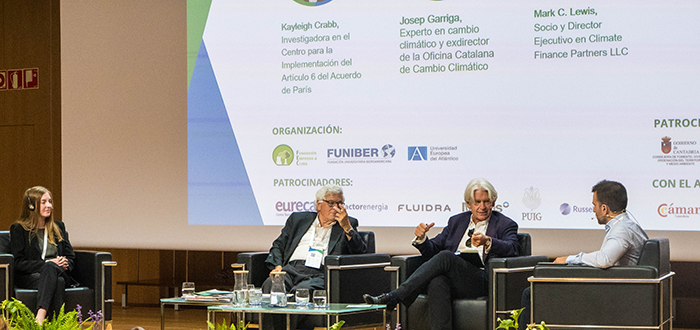
The sixth and final session of the International Climate Action Congress (CIACC 2026) focused on the importance of standards and certification systems in carbon projects as tools for ensuring their quality, transparency, and credibility. During the discussion, it was emphasized that having robust criteria and independent verification mechanisms is essential to ensure that these projects result in actual reductions or eliminations of emissions and deliver on the promised environmental and social benefits. It was also emphasized that these standards strengthen confidence in carbon markets and help ensure that investments aimed at mitigating climate change are used effectively, responsibly, and in a verifiable manner.
The session began with a keynote address by Josep Garriga, an expert on climate change. This was followed by a roundtable discussion featuring Mark C. Lewis, partner and CEO of Climate Finance Partners LLC, and Kayleigh Crabb, a researcher at the Center for the Implementation of Article 6 of the Paris Agreement.
Closing of the Conference
The closing ceremony of the 5th International Climate Action Congress 2026 was graced by the distinguished presence of Elvira Carles, director of Fundación Privada Empresa y Clima; Santos Gracia, president of the Iberoamerican University Foundation (FUNIBER); Rubén Calderón, honorable rector of UNEATLANTICO; and Eloy Planes, CEO of FLUIDRA, one of the conference’s sponsors.
Planes defended the role of the CIACC as a forum for reflection and foresight, designed to address major challenges before they become apparent or urgent. During his remarks, Planes explained that the goal of the conference is “to bring these issues to light before they become obvious to everyone,” as well as “to open up the conversation before it becomes inevitable.” In his view, the ability to anticipate the future allows for better decision-making and helps prepare companies and institutions for the changes ahead, and he concluded with a final reflection on the importance of events like this one: “This conference helps us broaden our perspective before reality forces us to do so in a hurry.”