


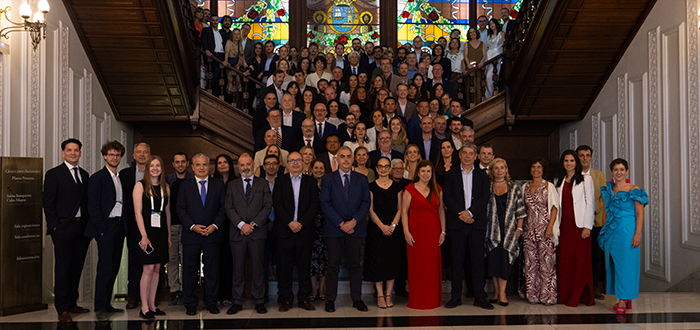
The Universidad Europea del Atlántico (European University of the Atlantic, UNEATLANTICO), the Iberoamerican University Foundation (FUNIBER) and the Fundación Privada Empresa y Clima (Private Foundation for Business and Climate, FEC) have inaugurated the 5th International Climate Action Congress (CIACC 2026), which is taking place on July 1st and 2nd in Santander and, for the fifth consecutive year, is being hosted at UNEATLANTICO’s facilities, thereby consolidating the Cantabrian capital’s status as an international leader in climate action.
The opening ceremony, held in the university’s auditorium, was attended by Rubén Calderón, Rector of the university; Santos Gracia, President of the Iberoamerican University Foundation (FUNIBER); Juan Luis Martín Ayala, Vice-Rector for Research and Knowledge Transfer at UNEATLANTICO; Elvira Carles, Director of the Empresa y Clima Foundation; and Roberto Media, Secretary of Public Works, Housing, Land Use Planning, and the Environment.
1st Session. Financial and Physical Risks of Climate Change for Businesses
The first session, titled “Financial and Physical Risks of Climate Change for Businesses,” featured Paula Romero, director of Alternative Risk Transfer Solutions at Aon Spain. During her presentation, Romero analyzed how climate risks are increasingly affecting corporate performance, distinguishing between acute risks, such as extreme heat waves and wildfires, and chronic risks, including rising temperatures and sea level rise.
She also emphasized that companies that adopt adaptation and sustainability strategies can not only reduce the negative effects of climate change but also turn some of these risks into new business opportunities.
The event included a roundtable discussion featuring prominent international experts: Juan María Marqués, sales director for Iberia and Central Europe at Descartes Underwriting (Madrid); Hannes Matt, startup advisor and ESG risk manager (Germany); Antonio Soria, unit head at the European Commission’s Joint Research Center (JRC) (Spain); and Augustin Lion Atlan, climate risk expert at the Bank of France.
2nd Session. Current Status of Regulatory Changes. How Do They Affect Us?
The second session addressed the current status of regulatory changes and their impact on businesses, led by Núria del Pozo, legal director of the Fundación Empresa y Clima. The expert analyzed the amendments introduced by the Omnibus Directive and the changes related to the Corporate Sustainability Reporting Directive (CSRD), as well as developments in the European Sustainability Reporting Standards (ESRS).
During her remarks, del Pozo explained that the NEIS have an architecture similar to the GRI standards and reviewed the main points of the reform, including the simplification of certain obligations, the planned exemptions, the new EFRAG proposal, and the timeline for implementing the measures, which continues to generate differing views among Member States and the business sector.
Del Pozo also discussed the future European Sustainability Reporting Standards for non-EU Groups (N-ESRS), which are intended for companies outside the EU that operate within the EU. These regulations, which are still in the draft stage, will be subject to a 100-day public consultation during the second half of July 2026, and the technical advice to the European Commission is expected to be ready in January 2027.
She also emphasized that one of the European Union’s objectives is for all companies to report using uniform standards and highlighted the dual materiality analysis—an approach that assesses both how environmental, social, and governance (ESG) factors affect a company’s financial performance and the impact the organization itself has on the environment and society. This methodology, as she explained, provides a significant advantage in terms of trust and credibility in the market.
Following her presentation, another roundtable discussion was held, bringing together Paula Baldó, a strategic sustainability consultant (Spain); Pedro Faria, environmental leader at EFRAG (Belgium); Ramón Pueyo, partner in charge of sustainability and good governance at KPMG (Spain); and Maria Tymtsias, co-founder of Palau and chief community & sustainability officer (Belgium).
3rd Session. Positive and Negative Impacts of Artificial Intelligence on Sustainability
The event also included a session on the positive and negative impacts of artificial intelligence on sustainability, an area that is gaining prominence in the ecological transition. The experts agreed that AI has become a key tool for decarbonization and the development of sustainable solutions in sectors such as health, education, industry, and environmental management. The session began with a keynote presentation by Roger Pastor, an entrepreneur, consultant, and public speaker specializing in innovation, digital transformation, and artificial intelligence.
This was followed by a roundtable discussion featuring Ana Lilia Barbosa, founder and director of Ágora Educación (Mexico); Alexandra Lillo, senior specialist in AI regulation and ethical governance at the Catalan Observatory on Ethics in Artificial Intelligence (Spain); Soumya Sarkar, full professor of electronics at the University of Southampton (United Kingdom); and Pol Torres, head of the Energy and Agri-Food research line at Eurecat’s Applied Artificial Intelligence Technology Unit (Spain).
However, it also became clear that its growth poses significant challenges related to energy and water consumption, as well as the social and ethical implications arising from its use. In this regard, the need to promote more efficient, responsible, and accessible artificial intelligence models was emphasized, especially given that more than half of Spain’s adult population has already used a tool based on this technology.