


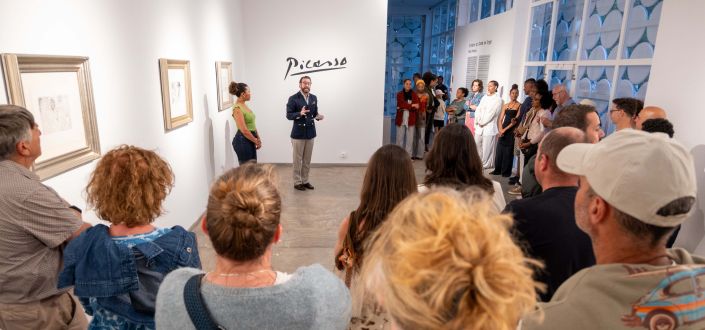
The Obra Cultural de FUNIBER (Cultural Work of FUNIBER) and the Universidad Europea del Atlántico (European University of the Atlantic, UNEATLANTICO), together with the Fundación Canaria para la Acción Exterior (Canary Islands Foundation for External Action, FUCAEX) of the Government of the Canary Islands and Casa África, present the exhibition «El Entierro del Conde de Orgaz»,, by the Spanish artist Pablo Picasso, at the National Center for Art, Craftsmanship and Design (CNAD) in Mindelo, Cabo Verde. The project also has the High Patronage of the Presidency of the Republic of Cape Verde, which emphasizes its institutional relevance.
The FUNIBER Cultural Work continues to strengthen the cultural ties between Spain and Cabo Verde with the arrival of the exhibition “El Entierro del Conde de Orgaz” in the city of Mindelo, on the island of São Vicente. This new stop is part of the itinerancy of the Cultural Work through the archipelago, consolidating itself as one of the most outstanding cultural initiatives of the year in the country. The exhibition will remain open until July 12.
The exhibition is exhibited at the National Center for Art, Craftsmanship and Design, one of the most relevant cultural spaces in the country. This center thus becomes the stage that hosts a unique artistic proposal, of great historical and creative value.
The exhibition presents a set of 13 engravings made between 1957 and 1958 by the famous Spanish artist Pablo Picasso, a key figure in contemporary art and master of cubism. These works are part of a unique surreal automatic writing experiment developed by Picasso with the renowned Spanish poet Rafael Alberti. The result is a fusion between image and word that challenges traditional forms of artistic and literary expression, offering the viewer a surreal aesthetic experience.
The itinerancy of “El Entierro del Conde de Orgaz” in Cabo Verde not only brings local audiences closer to a little-known work by Picasso, but also reaffirms FUNIBER’s commitment to promoting Spanish culture internationally. Through initiatives like this, the Ibero-American University Foundation contributes to generating spaces for intercultural dialogue, fostering artistic exchange and mutual enrichment among communities.
It is the second stop of this exhibition in Cabo Verde, after its passage through Praia. The arrival of the exhibition in Mindelo represents a new opportunity for residents, visitors and tourists to discover an experimental facet of the genius of Malaga, in a context that combines history, art and international cooperation.