



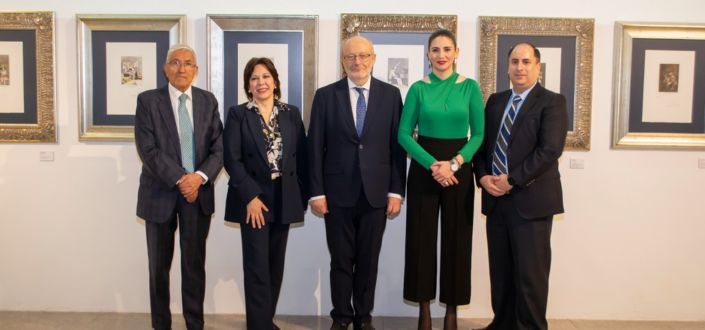
On 18 March, the Universidad Europea del Atlántico (European University of the Atlantic, UNEATLANTICO) and the FUNIBER Cultural Foundation held the opening of the exhibition ‘From Whim to Nonsense’ by Goya and Dalí at the National Art Museum (MNA) in La Paz (Bolivia).
The exhibition, located in the Sala Patio de Cristal at the National Art Museum, will be open to visitors from 19 March to 10 May. It will subsequently travel to the regions of Santa Cruz and Cochabamba, according to the Spanish Ambassador in La Paz, Fernando García Casas, speaking to the EFE news agency. This exhibition is the result of a collaboration between the European University of the Atlantic (UNEATLANTICO), the Ibero-American University Foundation (FUNIBER), the Spanish Embassy in Bolivia and the Cultural Foundation of the Central Bank of Bolivia (FC-BCB).
It comprises 80 engravings by Goya and Dalí and reflects the complex genius of Goya’s art and the surreal universe that Dalí integrated in perfect harmony with the scenes from Goya’s Caprichos.
From a contemporary perspective, there are three aspects of particular interest to consider in the contemplation, analysis and interpretation of Goya’s two series of Caprichos: his original and Dalí’s recreation.
Firstly, the original series, which has been known, studied and interpreted ad nauseam, therefore boasts a rich context covering stylistic, semantic and pragmatic aspects; knowledge of this allows us to enrich the mere denotation of the engraved scene without limit, with biographical, political, social and other connotations, and even to undertake an analysis of its diachronic development from its creation to the present day, in which, as this very text demonstrates, it continues to be a subject of interest and study.
Secondly, the recreation of Dalí, which maintains the original motif of Goya, colors and fills it with motifs from his surrealist universe, in addition to adding an irrational title that masks the message bounded by the texts in Goya’s originals. The knowledge of the first analysis, that is, of the authentic whims of Goya, is essential to assess the performance that Dalí has made and how this transforms its original meaning.
Thirdly and finally, a much more cultured and elaborate vision that transcends the two series of los caprichos to assess from them the influence of Goya on surrealism in general and especially on the work of Salvador Dalí.