



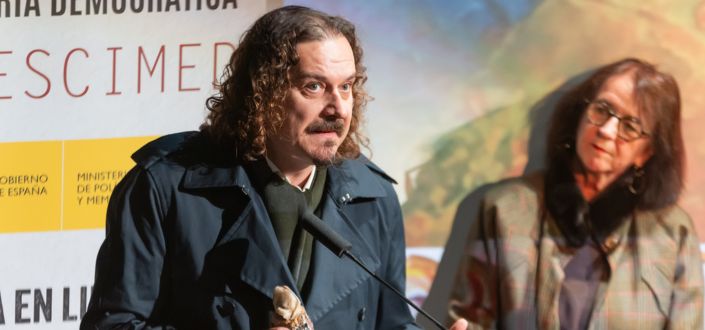
Maestro Dr Gil de Gálvez, associated with the Cultural Work of FUNIBER and the Universidad Europea del Atlántico (European University of the Atlantic, UNEATLANTICO), received the award for best original soundtrack at the International Film Festival for Democratic Memory FESCIMED 2025 at the Film Academy in Madrid for the piece ‘Abbey Gate,’ which provides the music for the film Au Revoir Kabul, selected from more than 6,500 entries from 40 countries.
This film narrates the desperate attempt by thousands of Afghans to flee through Kabul airport following the withdrawal of US troops.
An elegy for violin and strings composed by Gil de Gálvez and Carlos Celis and performed by Gil de Gálvez himself and the Ensemble Músicos Concerto Málaga.
The film was directed by Latifa Sakhizada, Antonio Pampliega and Alfredo Lobo. Juan Pablo Gamarro was the executive producer of the recording and Cheluis Salmeron was responsible for the sound recording, with the support and production of the Fundación Hispania Música and its audiovisual label Belsuono String Records.
The soundtrack is named Abbey Gate in memory of the ‘Abbey’ gate at Kabul airport, as a symbol of the traumatic Afghan exodus. The piece is based on the country’s traditional music, currently banned by the Taliban. It is a work inspired by the sounds of the rebab, the most important instrument in Afghan folklore, and rhythms and dances such as the ‘Afghan ghazal’, with nods to ‘Raftim Azin Baagh’ and the ‘naghma’ style.
UNEATLANTICO congratulates the maestro on this musical work, which represents a valuable contribution to the dialogue between art, memory and social commitment.
The maestro closes another year linked to the Cultural Work of FUNIBER and the European University of the Atlantic (UNEATLANTICO). In October, he gave several concerts in El Salvador and Bolivia as part of the celebration of Hispanic Heritage Day.
In June, Gálvez gave a lecture entitled ‘Background, origin and evolution of the Spanish National Anthem’, organised by the Spanish Academy of Diplomacy and the ‘Diplomacy and Civil Society’ Forum, within the framework of the Royal Economic Society of Friends of the Country of Madrid (RSEMAP).
His presentation took a historical and musical approach to the development of the Spanish National Anthem, from its possible popular origins to its first documented reference in 1761, contained in the Book of Regulations for the Playing of Fife and Drum in the Spanish Infantry, composed by Manuel de Espinosa.