



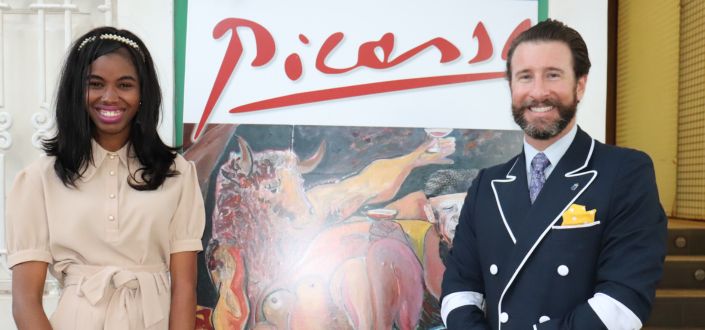
The Cultural Works of the Universidad Europea del Atlántico (European University of the Atlantic, UNEATLANTICO) and the Ibero-American University Foundation (FUNIBER), together with the Canary Islands Foundation for External Action (FUCAEX) of the Canary Islands Government and Casa África, present the exhibition ‘The Burial of the Count of Orgaz’ by Spanish artist Pablo Picasso in Praia, Cape Verde.
The exhibition is located at the FUCAEX headquarters in the city of Praia and will remain open until 12 March. The exhibition was inaugurated by the President of the Republic of Cape Verde, José Maria Neves, continuing on from the Joan Miró exhibition organised in 2023 and the Salvador Dalí exhibition organised in 2024.
With this initiative, FUNIBER, through its headquarters in Cape Verde, and in collaboration with FUCAEX, contributes to the culture and creative industries sector of Cape Verde, offering the public the work of Pablo Picasso, marked by his genius and provocative imagination, a unique opportunity to contemplate works by the Spanish artist who transformed the landscape of contemporary art.
About the collection ‘The Burial of the Count of Orgaz’
‘The Burial of the Count of Orgaz’ consists of a set of 13 engravings, made between 1967 and 1968, which appear as the visual part of an experiment in automatic surrealist writing carried out by Picasso and a proposal by the Spanish poet Rafael Alberti for a joint publication.
The set itself is closely related to Picasso’s pictorial work, a painting translated into words, as they share the same Picassian nature, the same spontaneity and the same light touch as in his painting. It is a surrealist prose poem in which he uses the technique of automatic writing, dispensing with punctuation marks, generating a torrent of thought in which ideas flow, scenes from childhood intermingled with surrealist images and eroticism… We find a nostalgic Picasso who longs for his childhood —and probably Spain after thirty years of exile— for Goya, Las Meninas, Coubert, the game of gori gori, the night of San Juan…
According to Federico Fernández, Director of Cultural Works at UNEATLANTICO and FUNIBER, the collection “shows Picasso’s knowledge of the techniques of André Breton’s group, and proof of this is the automatic writing published in facsimile accompanying the series of engravings and dated 1939. Perhaps it is a series for connoisseurs, a surrealist experience of the Count of Orgaz, where eroticism takes precedence.”
In this work, Picasso explores the new sensual universe he finds in the magnificent horn, adopting a direct, informal and almost automatic style, similar to the writing of this work, while maintaining the universe of his themes and characters. The people attending the Count’s funeral – El Greco’s universal work – are replaced by voyeurs watching the erotic scenes from behind the curtains, in which, as Hitchcock did in his films, the author appears as a character in at least one scene. Behind the curtain, the characters emerge in a timeless and synchronous mixture of the real and the imaginary, where fauns, nymphs, Goya himself, naked women, acrobats, 16th-century characters, dwarves, Cupid, Degas himself and the whole vast troop of Picasso’s imagination coexist in his scenes.