


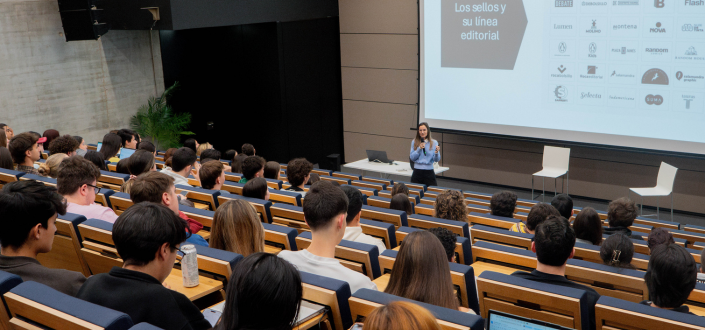
The Universidad Europea del Atlántico (European University of the Atlantic, UNEATLANTICO) hosted in its Hall of Acts Cristina Lomba, editor of the publishing group Penguin Random House, who gave a talk about her career and professional experience in the publishing sector. The activity, attended by students from different years of degrees in Audiovisual Communication (CA), Journalism (PER), Advertising and Public Relations (PRP), Business Administration and Management (ADE), and Computer Engineering (II). was developed within the framework of the subject Information and Knowledge Society.
During the meeting, the speaker began by sharing her beginnings in the professional field. She explained that she took degrees in Audiovisual Communication and Journalism, a training that later led her to develop her career in the publishing sector, in which she has already accumulated more than 14 years of experience. From his career, he introduced the students to the keys of their daily work, answering fundamental questions such as what an editor does, how the editorial world works and what is the importance of the relationship between editor and author in the process of creating a work.
Also, Lomba explained that he is currently responsible for the label “Aguilar”, belonging to the publishing group Penguin Random House. In this context, he explored the different types of collections that make up this seal, including books in first person – such as memoirs, biographies and testimonies -, works of popularization – focused on areas such as health, finance or science- and inspirational books, including journals and activity proposals.
In addition, he addressed the relationship between the publishing sector and the audiovisual field, analyzing the marketing strategies promoted by communication departments and the process of adaptation of literary works to other formats. In this sense, he highlighted key aspects such as agreements with producers and the impact that these adaptations can have both on the dissemination of stories and on increasing sales.
Finally, the editor answered various questions raised by students, which allowed to deepen both the functioning of the publishing sector and their personal vision about the profession. Subsequently, the students participated in a practical activity in which they had to present a case based on a real story and try to sell it to the editor as if it were an editorial project. This exercise fostered skills such as improvisation, exposure and research.
This type of initiative, framed in the subject Information and Knowledge Society of the European University of the Atlantic (UNEATLANTICO), allows students to approach directly the professional reality of the sector. In this way, the university strengthens its commitment to a training that combines theoretical knowledge with practical experiences aimed at preparing future professionals for the challenges of the current socioeconomic environment.