



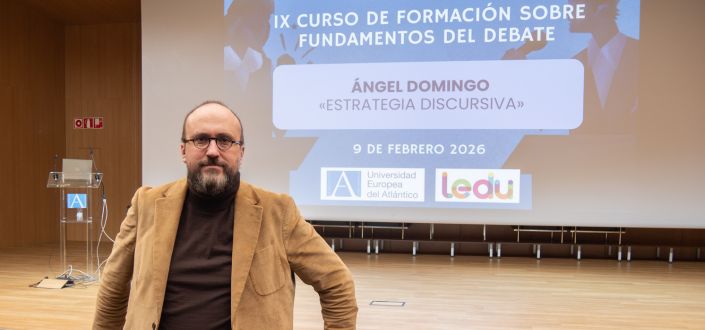
The Universidad Europea del Atlántico (European University of the Atlantic, UNEATLANTICO) has begun its traditional course of oratory before the Debate League with the presentation of Angel Domingo, Technical and Communication Director of the Spanish League of University Debate (LEDU).
Before starting the lecture, the professor and director of the Debate League, Luis Prado, thanked Ángel Domingo for being part of this course, which he made the closing presentation in the VIII edition of the same.
The talk focused on strategic decision-making and effective persuasion in academic debate. He stressed that it is not who knows better who wins, but who decides better what to do with the available knowledge. In addition, his intervention focused on the importance of clarity, choice of arguments and ability to guide the jury towards a concrete decision.
The LEDU director pointed out that the quantity of arguments does not imply quality, as the accumulation of reasons does not always lead to more informed decisions. On the contrary, clarity and relevance are decisive, as the jury evaluates what it is able to retain, compare and order. «The jury does not reward you for knowing, but for helping you decide», was one of the central ideas of the talk.
One of the most prominent concepts was discursive strategy, understood as the ability to prioritize, hierarchize and sacrifice arguments. Prioritizing means distinguishing the decisive from the interesting; ranking, ordering the internal weight of ideas; and sacrificing, even renouncing valid arguments that consume time and divert the focus of the main message.
Domingo also presented the strategic triangle of the debate, composed by the objective, the role of the jury and the role of each speech. The objective is to define what belief you want to generate in the jury at the end of the debate, while the jury, conditioned by human limits such as attention and memory, needs clear, structured and comparable speeches.
As for the structure, the four fundamental roles within a discussion team were explained: the builder, who sets the framework and context; the axis defender, who protects the central thesis; the comparator, who contrasts models and forces the jury to choose between two approaches; and the evaluator, who is responsible for organizing the discussion and translating it into a clear decision at closure.
The talk also addressed the architecture of debate, composed of opening, development, shock and closure. Domingo emphasized that refuting is not simply replying, but strategically discrediting the rival’s arguments, and that closure is key to guiding the jury towards a convincing conclusion.
Finally, different argumentative strategies were reviewed, such as the defence of values and standards, the minimisation of the impact of opposing arguments, the clarity strategy-which reduces the debate to a single decisive question-and the use of metrics to measure the impact of arguments. Time management and discursive economy closed an intervention that left a clear message: in the academic debate, clarity is what tilts the balance.